


The History of Acrylic Awards: From Plastic to Podium
Acrylic awards are a fairly recent arrival in a very old tradition. People have handed out trophies for thousands of years, but the clear, lightweight kind on most desks today only became common in the last few decades. Here's how a wartime plastic ended up on the podium.

Where Acrylic Came From
Acrylic is a clear plastic. Its chemical name is polymethyl methacrylate, or PMMA. Chemists developed it in the 1930s, and it reached the market under brand names you may still hear: Plexiglas, Lucite, and Perspex.
World War II is what really put it to work. Acrylic was light, strong, and see-through, so it went into aircraft canopies, gun turrets, and periscopes. By the time the war ended, factories knew how to make a lot of it.
After the war, that capacity moved into everyday life. Through the 1950s and 1960s, designers used acrylic in furniture, signs, and architecture because it was clear like glass but far lighter and harder to break. Somewhere along the way, people started shaping it into desk pieces and display blocks. The "Lucite tombstone" given to mark a finished business deal is one well-known example.
How Acrylic Reached the Awards Industry
Recognition pieces used to mean wood, metal, or glass. Each looked the part, but each had a catch:
- Wood: Warm and classic. Still the heart of many plaque awards, but hard to shape into modern forms.
- Metal: Durable and prestigious. Medals and metal trophies cost more and offer less design freedom.
- Glass: Elegant and crystal-clear. Glass awards are also heavy, fragile, and pricey to ship.
Acrylic fixed the parts people complained about. It looks like glass but weighs less and resists shattering. It costs less than glass or crystal, so a small club and a large company can both afford it. And it takes detailed customizing well. As acrylic manufacturing matured, suppliers could cut, shape, and personalize it in ways wood and metal couldn't match. By the 1980s and 1990s, clear acrylic was a standard choice for corporate, school, and sports recognition.
What Acrylic Awards Look Like Today
The material hasn't changed much. The decorating has. A few things you'll see on modern acrylic awards:
- Laser engraving: A laser cuts crisp text and logos right into the surface. No deep sandblasting needed.
- Color and UV printing: UV printing lays full-color logos and art directly onto the acrylic, and tinted blanks add color from the start.
- Embedded pieces: Metal emblems, photos, or other objects can sit inside the acrylic for a layered look.
- Custom shapes: From geometric forms to cut silhouettes, acrylic can be shaped into almost anything.
- The sustainability question: Acrylic is a petroleum-based plastic, not a recycled or renewable one, so its real environmental edge is longevity: a quality piece lasts for years instead of getting tossed. We cover this in our honest look at acrylic and sustainability.
Why People Still Pick Acrylic
The reasons line up with how it's used. Companies reach for it because it looks professional and carries a logo cleanly, which suits employee milestones, sales goals, and client thank-yous. Schools and universities hand it out for academic and athletic honors. Sports clubs like that it's tough enough to survive a trophy case and cheap enough to order in bulk. Charities and community groups get a piece that feels meaningful without straining a small budget.
Across all of them, the same traits keep showing up: you can match it to your brand, it shows logos and colors sharply, it costs less than glass or crystal, and it holds detail well. That mix is why a wartime plastic now sits on so many shelves.
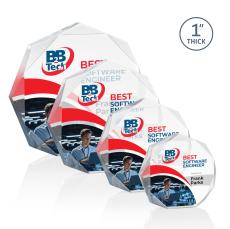 Piedmont VividPrint Award - Clear
 Beckenham VividPrint Award - Gold
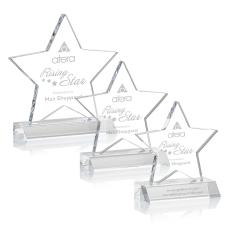 Nelson Star Award
 Beckenham VividPrint Award - Silver
 Beckenham VividPrint Award - Blue
 Lansing Award - Clear (Vert)
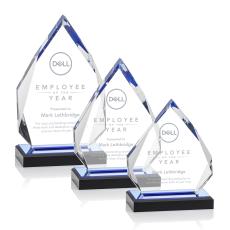 Beckenham Award - Blue
 Custom Logo Cut Awards
Order Acrylic Awards From Awards.com
We've been making recognition pieces for 40 years, since 1985, at our US and Canada facilities. Every acrylic award comes with free engraving and free logo and setup, so the price you see covers the customizing too. You also get our 100% satisfaction guarantee and lowest price guarantee. Pick a piece, send us your art, and we'll handle the rest. If you want a closer look at the process, here's how acrylic awards are made.
Acrylic Award History FAQ
When were acrylic awards invented?
The plastic itself came first. Chemists developed acrylic, or PMMA, in the 1930s, and it sold under names like Plexiglas, Lucite, and Perspex. Shaping it into recognition pieces came later. By the 1980s and 1990s, clear acrylic was a standard pick for corporate, school, and sports awards.
What is acrylic made of?
Acrylic is a clear plastic called polymethyl methacrylate, or PMMA for short. You may also hear it called lucite. It looks like glass but weighs less and is much harder to break, which is why it works so well for acrylic awards.
Why did acrylic replace glass and metal for awards?
It fixed the parts people complained about. Acrylic looks like glass but weighs less, resists shattering, and costs less than glass or crystal. It also takes detailed customizing well, so suppliers can cut, shape, and personalize it in ways wood and metal can't match.
What does "Lucite tombstone" mean?
It's the clear acrylic block given to mark a finished business deal. The name is one of the better-known early examples of acrylic used as a desk piece, long before it became common for trophies and plaques.
How are acrylic awards customized today?
Mostly with laser engraving and UV printing. A laser cuts crisp text and logos into the surface, while UV printing lays full-color art directly onto the acrylic. At Awards.com, engraving plus logo and setup are free, there's no minimum order, and most orders ship in 5 to 7 business days after a proof in 2 business days.