


Why Employee Recognition Matters More in a Tight Labor Market
When the labor market tightens, the people you already have become your most valuable asset - and recognition is one of the cheapest, fastest ways to keep them. Smaller teams mean every person carries more weight, so losing a good employee hurts more and costs more to replace. Recognition keeps your best people feeling seen, which keeps them on the payroll.
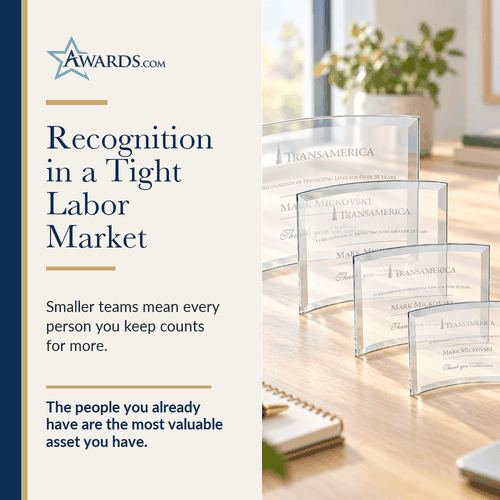
Hiring has slowed in a lot of industries. Teams run leaner, the same work gets spread across fewer people, and the employees who stay are asked to do more. That changes the math on retention. When you can't simply backfill a role, holding onto the people who know your business matters a lot more than it used to.
This is where recognition earns its keep. It's not a perk or a morale gimmick. It's a practical way to tell your most experienced employees that the extra responsibility they're carrying gets noticed.
Why losing people hurts more when teams are lean
Turnover has always been expensive. On a small team it's worse. When one person leaves, their work doesn't disappear - it lands on the coworkers who stay, on top of everything those coworkers already do.
Replacing that person takes time too. You post the role, screen candidates, interview, train, and then wait while the new hire learns how things actually work. Even a fast hire rarely matches an experienced employee's output for months. Every week of that gap is a week your team runs short-handed.
So keeping the people you've got is no longer a soft "nice culture" goal. It's how you protect output when there's no slack in the system.
What employee recognition actually is
Recognition means telling employees their work matters and pointing to the specific thing they did. That's it. A manager calling out a great save in a team meeting counts. So does a peer thank-you, a service anniversary, or a trophy handed out at a year-end event.
The form matters less than the habit. Recognition that shows up regularly (not just at review time) is what makes people feel valued instead of taken for granted.
How recognition keeps people engaged
Engaged employees stay longer and put in more effort, and recognition is one of the clearest signals that drives engagement. When someone hears that their work made a difference, they get direct proof that the extra effort was worth it.
That signal matters most on a stretched team. People taking on new duties and shifting priorities want to know the workload is seen, not just expected. A few words of genuine recognition do more for loyalty than a lot of managers expect.
Where formal awards fit
Day-to-day appreciation does the heavy lifting, but a physical award still carries weight that a passing "good job" can't. A crystal trophy or an engraved plaque is something an employee keeps. It sits on a desk or a shelf and reminds them (and everyone who walks by) what they pulled off.
Most companies build that into a few standard recognition programs: Employee of the Month or Year, sales achievement awards, leadership recognition, team awards, and years of service awards. Each one gives people something concrete to aim for and a clear sign of what the company values.
Recognition shapes the culture you want
What you reward is what you get more of. Recognize teamwork and people collaborate. Single out a creative fix and you tell everyone that initiative pays off. Call out great customer service and the whole team learns it's the standard. Over time, those small public moments add up to a culture where people understand what good work looks like and want to do more of it.
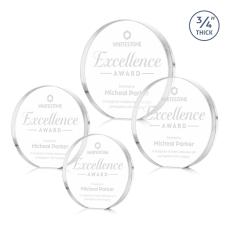 Gainsborough Circle Award - Clear
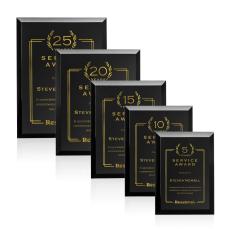 Merano Plaque - Gold
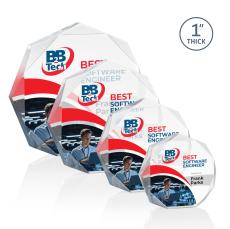 Piedmont VividPrint Award - Clear
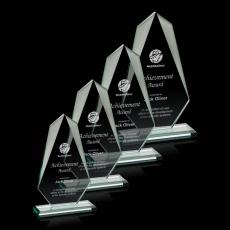 Jemma Award - Jade
 Beckenham VividPrint Award - Silver
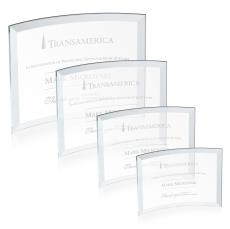 Madison Award - Clear
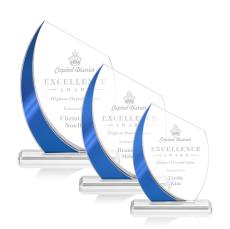 Wadebridge Award - Blue
 Custom Logo Cut Awards
A small investment that protects your team
Recognition costs little next to recruiting and training a replacement, and it pays back in people who stay. In a market where you can't easily hire your way out of a gap, that's not a feel-good gesture. It's how you hold your team together.
At Awards.com, we've helped companies do exactly that for 40 years. We make the crystal, glass, acrylic, plaques, and trophies that turn a thank-you into something people keep - from employee awards to custom milestone pieces. Engraving and logo setup are free, every order is backed by our 100% satisfaction and lowest price guarantees, and we ship from our warehouses across the US and Canada. Tell us who you're celebrating and we'll help you do it right.