


What Buyers Get Wrong About Crystal Awards
Ask ten people what "crystal" means and half will tell you it contains lead. It usually does not, and for an award, you would not want it to. The word carries a lot of old baggage, and that baggage leads buyers to the wrong questions. Here is what optical crystal and K9 crystal actually are, and the three things people get wrong before they buy.
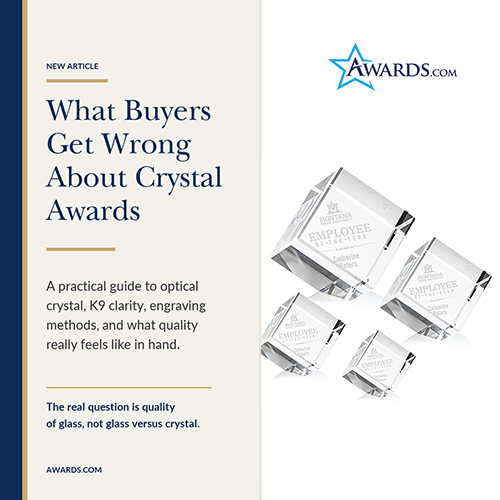
Crystal is a type of glass, not a different substance
Start here, because it clears up most of the confusion. Crystal is glass. The optical crystal and K9 crystal used in quality awards are lead-free glass, engineered for clarity and made to be cut and polished into precise shapes.
The old association between "crystal" and lead comes from lead crystal glassware, where lead oxide was added to boost sparkle and make cutting easier. Award crystal is a different material for a different job. K9 crystal, the grade you will see most often in high-end awards, is a lead-free optical glass prized for how clear and colorless it is. No cloudiness, no green tint at the edges, just clean glass that shows off the engraving.
So when a buyer asks "is this real crystal or just glass," the honest answer is that the line they are drawing does not exist the way they think. The real question is quality of glass, not glass versus crystal. For a full side-by-side, see our guide to the difference between glass and crystal awards.
Mistake one: thinking "crystal" alone tells you anything about quality
"Crystal" is a category, not a grade. Two awards can both be called crystal and be very different pieces.
What actually separates them:
Clarity and color. High-grade optical crystal like K9 is water-clear with no tint. Cheaper glass often shows a faint green or gray, most visible at the thicker edges. Hold a sample up to white paper and look at the edge. The tint hides there.
Weight and thickness. Good crystal has heft. That weight is part of why an award feels significant when someone picks it up. Thin, light pieces read as cheap in the hand no matter what the listing calls them.
Cut and polish. Precise facets and clean, polished edges catch light the way a quality piece should. Rough or uneven edges are the tell of a rushed piece.
Here is the line only someone who has handed over thousands of these will tell you: the recipient never reads the spec sheet. They pick the award up. Everything you are paying for, the clarity, the weight, the polish, is felt in that one second. That is what you are actually buying.
Mistake two: not understanding how the engraving is done
The engraving is where a crystal award goes from nice glass to a recognition piece, and buyers rarely ask how it is done. Two main methods, and they look different.
Sandblast engraving cuts into the surface with a stream of abrasive, leaving a frosted, white-etched mark you can feel. It stands out against clear crystal, holds up for the life of the piece, and is the traditional choice for names, years, and logos. It is what most people picture when they think of an engraved award.
Laser engraving, including 3D subsurface laser work, uses a focused beam. Subsurface laser can float an image or logo inside the crystal itself, which is how 3D crystal awards get that floating effect. Surface laser marks are finer and lighter than sandblasting.
Neither is better in the abstract. Sandblasting gives a bold, tactile mark that reads well from across a room. Subsurface laser gives depth and detail. Match the method to the piece and the message. For a closer look at how each one is done, see our guide to engraving techniques for crystal awards.
Mistake three: worrying about the wrong kind of durability
Buyers sometimes ask if crystal will fade or yellow. It will not. Crystal and glass are stable and hold their clarity for decades, and they are more UV-stable than acrylic, which can yellow over long exposure to strong light. If an award is going to sit in a sunny lobby for twenty years, crystal keeps its look.
The real durability question is handling. Crystal is glass, so it can chip or crack if dropped on a hard floor. That is not a flaw, it is the trade for the clarity and weight. Felt-padded bases, careful packing, and a shelf away from the edge of a desk handle it. For a piece meant to sit and be admired, crystal is the right material. For something that will be tossed in a bag and travel, that is a different conversation.
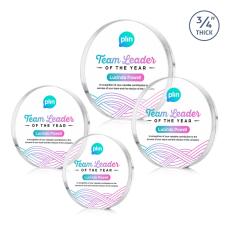 Gainsborough Circle VividPrint Award - Clear
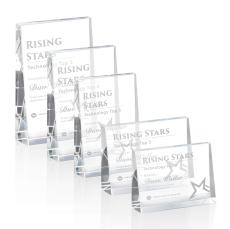 Tweed Award
 Hausner Award - Blue
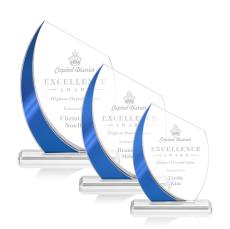 Wadebridge Award - Blue
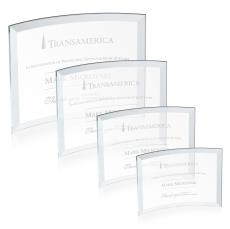 Madison Award - Clear
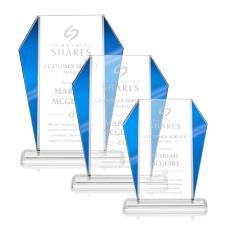 Newbury Award - Blue
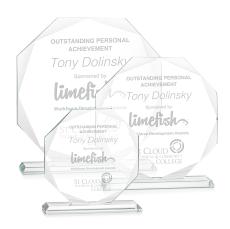 Kane Award
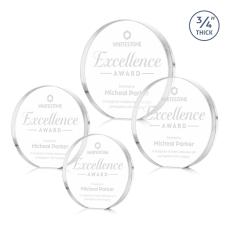 Gainsborough Circle Award - Clear
Choosing a crystal award with confidence
Skip the glass-versus-crystal debate. Ask about the grade of glass (K9 or optical crystal for the clearest look), check the weight and the edge color, and pick the engraving method that fits your design. Sandblasting for bold names and logos, subsurface laser for images and depth. Once you know what to look for, our guide to matching the award to the achievement helps you pick the right piece for each moment.
Browse the full crystal awards range, compare shapes like crystal star awards and 3D pieces, or look at our glass awards if you want a similar clear look at a different price. Every piece is engraved free, with a proof before we make anything.
Crystal Awards FAQ
Is crystal the same as glass?
Yes. Crystal is a type of glass. The optical crystal and K9 crystal used in awards are lead-free glass engineered for clarity. The difference between a crystal award and a plain glass one is the grade and quality of the glass, not two separate materials.
What is K9 crystal?
K9 crystal is a lead-free optical glass used in high-end awards. It is prized for being water-clear and colorless, with no green or gray tint at the edges, which makes engraving stand out cleanly.
Does crystal contain lead?
Award crystal like K9 and optical crystal is lead-free. The old link between crystal and lead comes from lead crystal glassware, which is a different material made for a different purpose.
What is the difference between sandblast and laser engraving?
Sandblasting cuts a frosted, white-etched mark into the surface that you can feel and see from across a room, ideal for names, years, and logos. Subsurface laser engraving floats an image or logo inside the crystal for a 3D effect. Both last the life of the piece.
Will a crystal award yellow or fade over time?
No. Crystal and glass hold their clarity for decades and are more UV-stable than acrylic, which can yellow after long exposure to strong light. Crystal keeps its look even in a sunny lobby.