


The Manufacturing Process Behind Acrylic Awards
An acrylic award starts as a flat sheet of clear plastic and ends as a polished trophy with someone's name on it. The steps in between are what separate a crisp, glass-clear piece from a cloudy one. Here's how it actually gets made.

What acrylic actually is
Acrylic is a plastic. Its full name is polymethyl methacrylate, or PMMA, and it's the same material you'll see sold as Plexiglas or Lucite. It's clear, light, and tougher than glass, which is why it holds up to shipping and handling that would chip a crystal award. It does have downsides: it scratches more easily than glass, and it's not an eco-friendly material on its own.
What makes acrylic work for awards is how well it shapes. You can cut it, bend it, and polish the edges until they look like glass, all without losing that clear, modern look people want on a desk. If you're curious how it got here, read the history of acrylic awards.
Cast vs. extruded: the grade matters
Not all acrylic is the same, and the type used decides how good the finished award looks.
- Cast acrylic is poured between two sheets of glass and cured, a process called cell casting. It's clearer, harder, and polishes to a better finish. This is the grade used for quality awards.
- Extruded acrylic is pushed through rollers in a continuous sheet. It's cheaper and fine for simple jobs, but it's softer and doesn't hold a clean polished edge as well.
If you want a piece that looks like glass and lasts, you want cast. The price difference shows up in the finish.
Cutting and shaping
Once the design is set, the sheet gets cut to shape. A few methods do the job:
- Laser cutting burns through the sheet for precise edges and intricate shapes. It also leaves a smooth, polished edge as it cuts.
- CNC routing uses a computer-controlled spinning bit, good for larger or thicker pieces and consistent shapes across a run.
- Saw cutting handles straight cuts and squaring up blanks before the finer work.
For shapes that aren't flat, acrylic can be heated and bent. Warmed to the right point, it gets pliable enough to form into curves or waves, then holds the shape as it cools.
Polishing the edges
Raw cut edges look frosty and dull. Polishing is what turns them clear, and it's the step that most separates a quality award from a cheap one.
- Flame polishing passes a controlled flame over the edge to melt the surface smooth and clear.
- Diamond polishing runs the edge against a diamond-tipped tool for a flat, optical-grade finish, the cleanest look you can get.
- Buffing with polishing compounds smooths out the surface and adds shine.
Decoration: engraving and printing
This is where the award gets personal. Two methods cover almost everything:
- Laser engraving uses a computer-controlled laser to mark names, logos, and text. It leaves a frosted, contrasting mark right in the surface, so it never wears off. This is the classic look for acrylic awards.
- UV printing prints ink straight onto the surface on a flatbed printer, then cures it instantly with UV light. It handles full-color logos, photos, and graphics, which engraving can't do.
One thing acrylic awards don't get is deep sandblast etching. That carved, recessed look belongs to crystal and glass. On acrylic, the marking sits at or near the surface.
Assembly, inspection, and shipping
Plenty of awards are built from more than one piece, like a standing acrylic block on a base. Those parts get bonded with acrylic adhesive, aligned, and checked. Every piece gets inspected for scratches, bubbles, and bad edges before it ships, then it's sleeved and boxed so it arrives clean.
Why buy from Awards.com
We've been making custom awards since 1985, 40 years now, at our US and Canada facilities. Engraving is free, and so is your logo and setup. Every order is backed by our 100% satisfaction guarantee and our lowest price guarantee. Browse our custom acrylic awards and we'll handle the rest.
Acrylic Manufacturing FAQ
What's the difference between cast and extruded acrylic?
Cast acrylic is poured between two sheets of glass and cured, a process called cell casting. It's clearer, harder, and polishes to a better finish, so it's the grade used for quality awards. Extruded acrylic is pushed through rollers in a continuous sheet. It's cheaper but softer, and it doesn't hold a clean polished edge as well.
How is acrylic cut and shaped for an award?
Laser cutting burns through the sheet for precise edges and intricate shapes, and it leaves a smooth, polished edge as it cuts. CNC routing uses a computer-controlled spinning bit, good for larger or thicker pieces. Saw cutting handles straight cuts and squaring up blanks. For shapes that aren't flat, the acrylic is heated until it's pliable, then bent into curves and held as it cools.
Why do acrylic edges need polishing?
Raw cut edges look frosty and dull. Polishing is what turns them clear, and it's the step that most separates a quality award from a cheap one. Flame polishing melts the surface smooth, diamond polishing runs the edge against a diamond-tipped tool for an optical-grade finish, and buffing with compounds adds shine.
Should I choose laser engraving or UV printing?
Laser engraving uses a computer-controlled laser to mark names, logos, and text. It leaves a frosted mark right in the surface, so it never wears off, and it's the classic look for acrylic. UV printing prints ink straight onto the surface and cures it with UV light, so it handles full-color logos, photos, and graphics that engraving can't do. Pick engraving for a clean classic mark and UV printing for color.
Does Awards.com charge for engraving?
No. Engraving is free, and so is your logo and setup. We've been making custom awards since 1985 at our US and Canada facilities, and every order is backed by our 100% satisfaction guarantee and lowest price guarantee.
 Beckenham VividPrint Award - Gold
 Beckenham VividPrint Award - Blue
 Custom Logo Cut Awards
 Lansing Award - Clear (Vert)
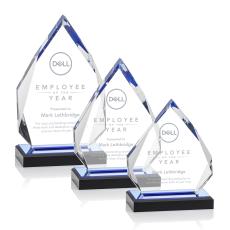 Beckenham Award - Blue
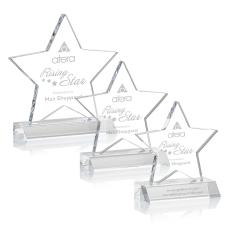 Nelson Star Award
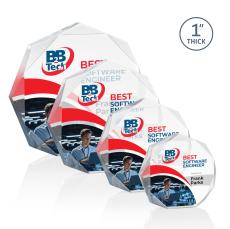 Piedmont VividPrint Award - Clear
 Beckenham VividPrint Award - Silver