


Recognition Program Ideas for Healthcare
Healthcare recognition has a scope problem no office has. A hospital runs 24/7, and for every nurse there is an environmental services tech, a dietary aide, a transporter, and a lab tech who keep the place running and rarely get named. This guide covers what a health system actually gives, from nursing excellence and good-catch safety reporting to the roles everyone forgets, how to run recognition across nights and weekends, and the mistakes that make a program ring false. Every award below is one hospitals give.
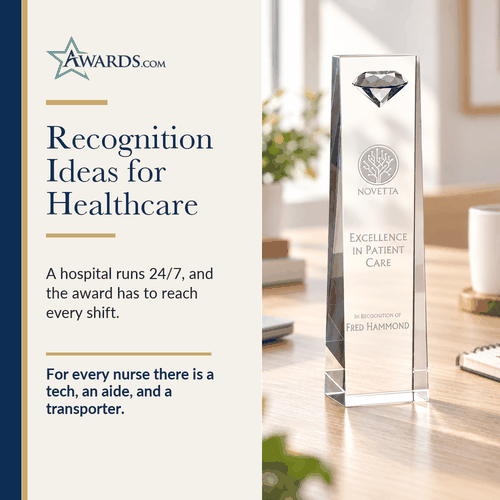
What Makes Recognition Different in a Hospital
A hospital is staffed around the clock, so a program that runs on weekday-daytime ceremonies skips the night shift, weekends, and holidays entirely. The people working the floor on a holiday are exactly the ones a program should reach first.
Clinical staff have no desk. A nurse cannot display a trophy at a station that is not theirs, so recognition here lives on a badge or lanyard pin, on a board on the unit, or as a piece that goes home. The wearable matters more in healthcare than in any other sector, because it travels with someone who is always moving.
The workforce is far bigger than nurses. Environmental services, dietary, transport, lab and imaging techs, security, and registration are most of the building and almost none of the recognition. In this industry, whether your program reaches them is the test of whether it is real.
Who nominates shapes how a program reads. A peer nomination from someone who was in the room, or a patient's own words written in by a family, carries more weight than a manager filling a quota.
The calendar drives a lot of it. Nurses Week, Hospital Week, and similar moments are real recognition anchors, but a program that only shows up during those weeks and goes silent the rest of the year reads as obligation, not appreciation.
The Awards a Health System Actually Gives
The award list a health system gives runs wide, and in healthcare that breadth means reaching past the clinical roles. Below are the award types by category, each with a sample line that carries a specific.
Service Milestones
Cover tenure and move on, since it works the same everywhere. See years of service awards, the service award program guide for cadence, and what service awards cost for budget.
Years of Service. The tenure ladder, and long tenure is common in healthcare: "25 years at the bedside, and the calm that comes with it."
Perpetual Service Award. A base that grows a bar each milestone, so a career shows on one piece.
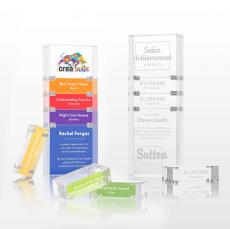
Pair it with the Magnetic Stacking Perpetual Award, from $25.50. A stacking base takes a new block each milestone, so a long clinical career builds on a single piece.
Nursing and Clinical Excellence
Nursing Excellence Award. The flagship clinical honor, and it lands hardest when peers and patients nominate rather than management: "For the shift no one else wanted, handled like it was nothing."
Preceptor and Mentor Award. For the nurse who trains the new grads and sets how a unit works: "For every new nurse who made it because of you."
Clinical Practice Award. For expertise that shows up in outcomes, not titles.
Rising Nurse Award. For the new graduate who found their footing fast on a hard unit.

Pair it with the Kane Award, from $51.50. A clean crystal reads as the flagship clinical honor, especially when a peer or patient nomination is engraved with it.
Patient Experience
Compassionate Care Award. Patient- and family-nominated, which is what makes it believable: "Nominated by a family who said you were the reason they were not afraid."
The shape can carry the message here. A heart award fits compassionate care the way a rectangle never will.
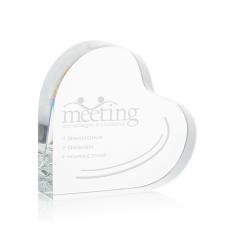
Pair it with the Kashmir Standing Heart Award, from $43.50. A crystal heart is the rare award shape that says the thing outright, which suits patient-nominated compassion.
Patient's Choice Award. Driven by what patients actually wrote, engraved with a line from the comment where it fits.
Service Excellence Award. For the experience scores a unit moved and held.
Patient Safety
Good Catch Award. The most important safety award in a hospital. It rewards the person who caught an error before it reached a patient, which is exactly the behavior you want more of: "For the catch that never became an incident."
Infection Prevention Award. For the unit that drove an infection rate down and kept it there.
Patient Safety Champion. For the person who makes speaking up about safety normal on their unit.
Certification and Growth
Certification Achievement Award. For earning a specialty certification on top of a full clinical load: "Certified this year, on your own time, while working full shifts."
Continuing Education Milestone. For the degree or credential finished while working the floor.
Team and Unit Awards
Unit of the Quarter. Recognizes a whole floor, which fits a setting where outcomes are a team result: "4 West. The unit everyone asks to float to."
Interdisciplinary Team Award. For the case that went right because nursing, pharmacy, therapy, and social work actually worked as one.
The Roles Everyone Forgets
Non-clinical and support roles are where a healthcare program proves itself. Name these on purpose.
Environmental Services Award. For the EVS tech whose work is the difference between an infection and a clean room: "For a hospital that is safe because you are thorough."
Dietary and Nutrition Award. For the people who get 400 meals right, on time, with the allergies flagged.
Patient Transport Award. For the transporter who is often the calmest face a scared patient sees all day.
Support Services Award. For lab, imaging, registration, and security, the roles that make care possible and rarely make a program.
Volunteers
Volunteer Service Award. Hospital volunteer corps run large and stay for decades, so their milestones deserve real recognition: "1,000 hours at the front desk, and a thousand first impressions."
Retirement
A retiring clinician has often given a whole career to one system. The plate should name the span and the mark they left: "34 years, 3 units, and a generation of nurses who learned it from you."
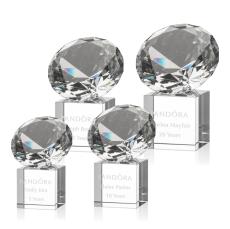
Pair it with the Gemstone Award on Cube - Diamond, from $58.50. A crystal piece suits a career honor a clinician will keep at home long after the last shift.
Employee of the Month Across the Hospital
Employee of the Month works in a hospital only when eligibility rotates across roles, not just nursing. Open the same month to EVS, dietary, transport, lab, and imaging techs so the people who keep the building running can win it, and run a separate track per shift so nights and weekends are eligible on their own terms rather than competing against a day shift that managers see more often. Draw the winner from peer and patient nominations, and read a line from the nomination when you present it on the unit.
Keep 2 pieces in play. A monthly award marks each winner, and a perpetual wall plaque lists a year of names on the unit where staff and patients pass it. See employee of the month plaques for the perpetual version and employee of the month awards for the monthly piece that goes home.
How to Run Recognition Across Nights and Weekends
Running recognition across nights and weekends is a coverage problem, across time and across roles. A program that reaches day-shift nurses and no one else fails most of the building.
Let peers and patients nominate, because in healthcare the source is the credibility. A short nomination form on the unit, and a way for patients and families to write in, produces recognition that a tired clinician will actually believe. Read a line from the nomination when you present it.
Present on the unit and on the shift, including nights and weekends. Recognition handed out only at a Tuesday-afternoon town hall never reaches the people who work when the offices are dark. Bring it to them.
Use wearables and unit-level pieces. A badge or lanyard pin travels with a nurse who has no desk, and a piece for the nurses' station recognizes a unit that has no single owner. Save the crystal for the honors that go home.
Anchor to the calendar without living there. Use Nurses Week and Hospital Week as high points, then keep a steady cadence the rest of the year so recognition does not vanish in June. Run service and milestones off a monthly list, with cadence in the service award program guide and engraving in our award wording examples.
Common Mistakes in Healthcare Recognition
The common mistakes in healthcare recognition are specific to a 24/7 building full of roles.
Recognizing nurses and forgetting everyone else. The signature mistake. When only clinical staff get recognized, the EVS, dietary, transport, and tech workforce, most of the building, learns the program is not for them. Build categories that name them first, not as an afterthought.
Running recognition on day-shift hours. The people working nights, weekends, and holidays are the ones a program should reach hardest, and they are the ones a weekday ceremony misses entirely.
Recognition that only appears during Nurses Week. A single week of appreciation followed by 11 months of silence reads as a box checked. The week should be a high point on a year-round program, not the whole program.
A safety program that punishes reporting. If catching and reporting a problem gets treated as a black mark, people stop reporting. A good-catch award does the opposite, rewarding the report instead of punishing it.
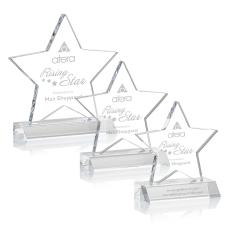 Nelson Star Award
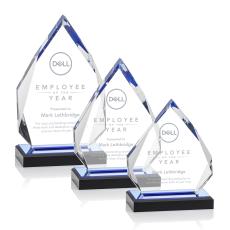 Beckenham Award - Blue
 Beckenham VividPrint Award - Silver
 Beckenham VividPrint Award - Blue
 Beckenham VividPrint Award - Gold
 Custom Logo Cut Awards
 Lansing Award - Clear (Vert)
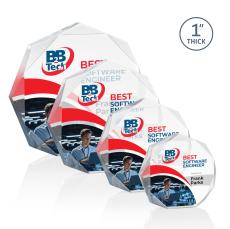 Piedmont VividPrint Award - Clear
Healthcare Recognition FAQ
What awards should a hospital recognition program include?
Beyond years of service, cover nursing and clinical excellence, preceptor and mentor recognition, patient experience and compassionate care, patient safety with a good-catch award, certification milestones, unit and interdisciplinary team awards, volunteer recognition, and dedicated awards for environmental services, dietary, transport, and techs. The breadth past the clinical roles is what separates a real program from a nurses-only one.
How do you recognize staff who work nights, weekends, and holidays?
Bring recognition to the shift instead of expecting people to come to it. Present on the unit during nights and weekends, and make sure milestones and awards are handed out by someone on that shift. A program that only runs during weekday office hours tells the people staffing the holiday that they are invisible, which is the opposite of the goal.
What is a good catch award?
A good catch award recognizes a staff member who caught an error or hazard before it reached a patient. It is the most valuable safety award a hospital can run, because it rewards speaking up rather than staying quiet. A safety program that punishes reporting teaches people to hide problems; a good catch award makes catching them something to be proud of.
How do you recognize environmental services, dietary, and support staff?
Give them named awards of their own, not a leftover category. An environmental services award, a dietary award, a patient transport award, and a support services award for lab, imaging, and registration recognize the roles that make care possible. In healthcare, whether a program reaches these people is the test of whether it is genuine.
Should patients be able to nominate staff for awards?
Yes, and it is one of the strongest moves available. A patient- and family-nominated award, like a compassionate care honor, carries a credibility no manager-selected award can match, because it comes from the person who was cared for. Engraving a line from the nomination makes the award something a clinician keeps for a career.
What kind of award works for a nurse with no desk?
Wearables and unit pieces work best day to day. A badge or lanyard pin travels with someone who is always moving, and a piece for the nurses' station recognizes a unit rather than an individual with nowhere to put a trophy. Save a crystal or plaque for the career honors, like nursing excellence or retirement, which go home.
How do you make Nurses Week recognition feel genuine?
Treat it as a high point on a year-round program, not the only time recognition happens. Staff notice when appreciation shows up for one week and disappears for the other 51. Name specific people and specific things during the week, keep a steady cadence the rest of the year, and it reads as real rather than as an annual obligation.
What should you engrave on a nursing service award?
The years and one specific line, not "valued employee." Something like "25 years at the bedside, and the calm that comes with it," or a line from a patient nomination. In a profession where the work is emotional, a specific detail that names what the person actually did carries far more than a generic title.