


Recognition, Reward, and Award: What Each One Means and Why the Difference Costs You
Recognition, reward, and award get used as if they are the same thing. They are not, and the difference is not academic. Confuse them and you budget for one while shopping for another, which is how a company talks itself into setting aside two thousand dollars for a physical award that costs under a hundred.

I sort these out with buyers all the time, so it helps to lay the terms out plainly. The cleanest definitions come from Recognition Professionals International, the nonprofit that sets the standards for this field. I hold their Certified Recognition Professional credential, so these are the definitions I work from. Here is each one, and where an award actually fits.
Recognition is the acknowledgment
Recognition, in RPI's framework, is the acknowledgment itself. It is the after-the-fact appreciation for something a person did, their effort, a behavior, a milestone reached, and it can be formal, informal, or an everyday thank-you. The word that matters is acknowledgment. Recognition is an act, not an object.
Telling someone their fifteen years mattered, in front of the people whose opinion they care about, is recognition. It costs nothing to mean. It is also the part most programs get wrong, and not because they spend too little. They say too little. A gift with no words attached is not recognition. It is just a gift.
A reward is the tangible thing
A reward is what you hand over as part of that recognition. RPI defines it broadly on purpose: a reward is any tangible item, benefit, or experience, and it runs from a cash bonus or a gift card to extra time off or event tickets. A reward is there to make the recognition land and stick.
The part worth sitting with is that cash is a reward, and so is a trophy. They are the same category doing very different work. That is exactly where budgets go sideways, because a company decides how much reward a milestone deserves in dollars, then tries to buy a single object at that number. The dollars belong to the reward. The object is only one kind of reward, and usually the cheaper kind.
An award is the durable reward
An award is a specific kind of reward. RPI does not break it out as its own term, and that is telling. An award is simply a tangible reward, the durable and symbolic one: a crystal piece, a plaque, an engraved recognition award.
What sets it apart from the other rewards is permanence. A gift card gets spent. Time off gets used. An award sits on a desk or a wall for years and keeps saying the same thing every time someone looks at it. That permanence is the whole reason an award is worth buying, and it is also why the award does not have to be expensive to do its job. The value is in what it stands for, not what it cost.
An incentive points forward, recognition points back
One more term, because it gets tangled in as well. An incentive, in RPI's terms, is a structured plan that rewards people for hitting goals set in advance. Do this, earn that. The direction is the whole difference. Recognition looks backward at something that already happened. An incentive looks forward at something you want to happen.
A sales contest is an incentive. A twenty-year service award is recognition. Both can hand over a reward, which is why people mix them up, but they are aimed at opposite ends of time. Budget them separately, because they answer to different goals.
Why the difference costs you money
Here is where the words turn into dollars. Recognition is the act and costs nothing to mean. The award is a durable reward, and for service milestone awards our order data puts it between about $60 and $100. A cash bonus is a different reward doing a different job, and it can be any size you like.
Trouble starts when a company sizes a reward, decides a twenty-year milestone is worth two thousand dollars, then goes looking for an award to match. There is no award at that price, and there never needed to be. Split it. Let the award be the award, and put the rest in a bonus where it does the job cash is good at. For the full order-data version of that argument, see what service awards actually cost.
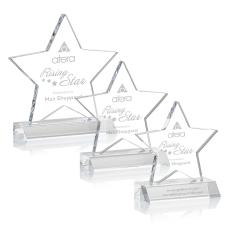 Nelson Star Award
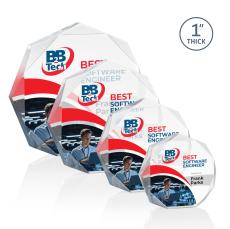 Piedmont VividPrint Award - Clear
 Custom Logo Cut Awards
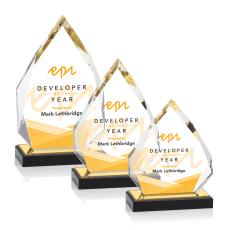 Beckenham VividPrint Award - Gold
 Lansing Award - Clear (Vert)
 Beckenham VividPrint Award - Silver
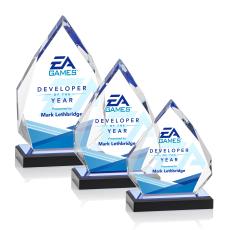 Beckenham VividPrint Award - Blue
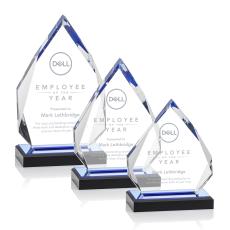 Beckenham Award - Blue
Recognition, Reward, and Award FAQ
What is the difference between recognition and a reward?
Recognition is the acknowledgment, the act of appreciating what someone did. A reward is the tangible thing handed over as part of it, which can be a cash bonus, a gift card, time off, or an award. Recognition is the message; the reward is the object that carries it.
Is an award a reward?
Yes. An award is one kind of reward, the durable and symbolic one. Recognition Professionals International groups tangible items like trophies and plaques under rewards. What makes an award distinct is permanence: it lasts and stays attached to the accomplishment, where cash and gift cards get spent and forgotten.
What is the difference between recognition and an incentive?
Direction in time. Recognition looks backward and appreciates something that already happened. An incentive is a structured plan that looks forward and rewards people for hitting a goal you set in advance. A service award is recognition; a sales contest is an incentive.
How much should an award cost?
Less than most companies expect. For service milestones, order data puts the typical award between about $60 and $100, and the whole career ladder under $600. If your budget is larger, that money is a reward better delivered as a cash bonus, not spent trying to find an expensive object.