


How Award Plaques Are Made
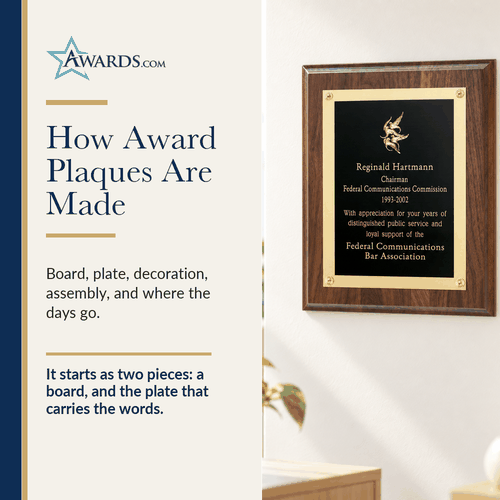
A plaque starts as two separate pieces: a board or base, and a plate carrying the name, logo, and message. Each piece is cut and finished on its own, the plate is decorated with the wording, and then the two are mounted together and inspected before the order ships.
The Board or Base
The base is what gives a plaque award its size, weight, and personality. Wood is the traditional choice, usually walnut, cherry, or rosewood, and it stays the most common board because it looks formal without trying too hard. Glass and acrylic bases read as more modern, with clean edges and a bit of shine on a desk or shelf. Metal bases show up on athletic and safety awards where a plaque needs to hold up to rougher handling. Marble and stone bases are the heaviest option, chosen when the award is meant to feel permanent, like a retirement gift or a company milestone piece.
The board is cut to size, sanded or polished on the edges, and finished before it ever meets the plate. For a closer look at how these materials compare on cost, weight, and durability, see award material options.
The Plate and How the Words Go on It
Most plaques carry a separate plate, usually metal, acrylic, or a color-fill blank, mounted onto the board. How that plate gets its text depends on the material and the look the buyer wants.
Laser engraving is a surface process. A laser burns fine detail directly into the top layer of the material, which makes it the right call for small text, logos, and even photo-style images. It works on most plaque materials, including acrylic, and it's the method behind how award engraving is typically done on metal and plastic plates.
Deep sandblasted etching is a different process entirely. Instead of a laser, a blasting stream cuts down into the surface, leaving a frosted, tactile mark that reads white and never fades or flakes off. This method belongs to crystal, glass, marble, and stone. It is not used on acrylic, where sandblasting would be overkill and a laser does the job. You can see the process in more detail in our guide to engraving vs etching.
UV full-color printing is a flatbed process that prints and cures full-color artwork or photos directly onto the surface. It performs best on acrylic, where it produces sharp, saturated color that resists scratching and fading far better than a painted finish. Read more on the UV printing page.
Color fill is the finishing step used with etched pieces. After a design is sandblasted or engraved into the surface, paint is worked into the recessed lines by hand and the excess is wiped clean, leaving color sitting inside the etched area rather than on top of it.
Mounting and Assembly
Once the plate is decorated, it gets mounted to the board. Depending on the design, that's done with recessed screws, a strong adhesive, or a routed channel that holds the plate flush with the surface. Corners and edges get a final check, backing felt or a stand is attached if the piece sits on a desk, and a hanger goes on if it's meant for a wall. Multi-piece plaques, like a wood board with a metal plate and a separate emblem, go through this fitting step by hand so everything lines up square before the final inspection.
The Proof Step and Turnaround
Before anything goes into production, you get a free digital proof showing exactly how the text, logo, and layout will look on the finished piece. Proofs typically come back within 2 business days, and nothing is cut or engraved until you approve it. Once you sign off, the order ships in 5 to 7 business days. This step matters more than it sounds like: a plaque is a one-shot piece, and catching a spacing issue or a misspelled name on the proof is a lot easier than catching it after the fact.
 Walnut Plaque w/Gold Edge Plate
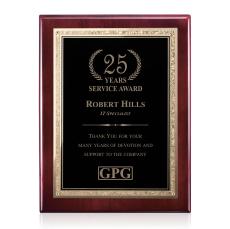 Gemstone Rosewood Plaque - Rosewood/Black Elegance
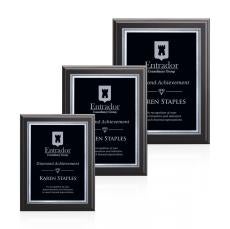 Farnsworth/Savoy - Black
 Merano Plaque - Silver
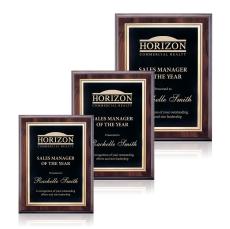 Farnsworth/Ashbury - Cherry/Black
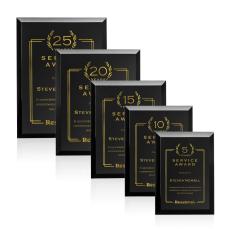 Merano Plaque - Gold
 Elegance Plaque
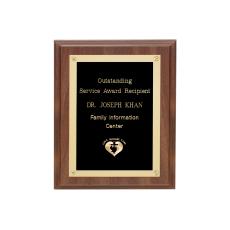 Walnut Finish Plaque w/Rosettes
How Award Plaques Are Made FAQ
How are the words put on a plaque?
The text goes on the plate, not the board, using one of a few methods: laser engraving for fine detail on most materials including acrylic, deep sandblasted etching for a frosted look on crystal, glass, marble, or stone, or UV full-color printing for vivid color on acrylic. Some etched designs also get color fill, where paint is hand-worked into the recessed lines.
What is the difference between laser engraving and sandblasted etching?
Laser engraving marks the surface with fine detail and works on most materials, including acrylic, glass, metal, and wood. Sandblasted etching cuts deeper into the surface and leaves a frosted finish. It's used on crystal, glass, marble, and stone, but not on acrylic or wood, which are laser engraved.
How long does it take to make a plaque?
You'll get a free proof to approve within 2 business days. Once you approve the proof, the plaque is cut, decorated, assembled, and shipped in 5 to 7 business days.
Are the plaques decorated in the US?
Engraving and decoration are done in the US, and much of the line is manufactured here as well. We also carry a dedicated Made-in-USA line for buyers who need that specific sourcing.
What holds the plate onto the board?
Most plates are set with recessed screws, adhesive, or a routed channel that keeps the plate flush with the board. The method depends on the plate material and the design, and it's fitted by hand before the final inspection.
Do plaques get made from scratch for every order?
Yes. The board is cut and finished, the plate is decorated with your specific text and logo, and the two are mounted together for that order. Nothing is engraved until you've approved a proof. For a look at where the plaque itself comes from, see our history of the award plaque.